Since its inception by Charles Babbage (during 1820 and 1871) the Computer has evolved from taking up a whole room of hardware just to run the simplest of programs, to being pocket-sized and capable of doing a limitless amount of things. This has allowed users to be involved in events across the world, from the security of their living room.
Now that everyone has their own personal computer, communication is instantaneous and everything can be accessed and shared immediately, there is a constant demand for updates, maintenance and improvements to what we have. Therefore, a new element has been added to the workforce which takes place in “Cyberspace”.
Cyberspace and the Internet create a change in the communication aspect of organisations, changing it from a hierarchical establishment, where people must report to and communicate through their superiors, to a distributed network, where people may communicate with whoever they need to, freely.
Now, The Internet gives Users, who were formerly a passive audience being sold information by larger gatekeeping corporations and the Government, the ability to share their own content and potentially reach just as many people as those larger entities and profiles do.
In this way, The Internet has become a “Libertarian Utopia” – a Digital Society where users have complete autonomy and freedom to do as they please.
As such, a Society based completely online, where its Subjects have complete freedom, with almost no input from the State, and where “All nodes are equal”, becomes a sort-of “Cyber Communist” Nation.
Get Smart (2008) is a fun and exciting adaptation of the 1965 series of the same name, which manages to take everything that’s fun and enjoyable from the original and modernises it. The movie focuses on newly-promoted Agent Maxwell Smart (an instantly likeable, bumbling, clumsy parody of James Bond), and his sophisticated, competent partner, Agent 99, who work for CONTROL, as they work to prevent the evil organisation KAOS from detonating a bomb in Los Angeles.
A few key changes to the film help to differentiate it from the tv series, such as the changing the role of Agent 99 from an infatuated yet competent sidekick, to a competent spy who refuses to work with Max due to his inexperience, however, slowly, she begins to like Max, despite his clumsy and foolish nature. The addition of Agent 23 (played by Dwayne “The Rock” Johnson) as well as the Chief (Alan Arkin) are extremely funny additions to the cast, providing plenty of dry humour as well as some touching and heartfelt scenes, and adding an interesting dynamic to Max and 99.
This movie changes just enough to modernise itself, whilst remaining faithful to the original, resulting in an extremely enjoyable watch. The film is a good watch for the whole family, with humour that people of all ages can enjoy, and is child-friendly.
Though it doesn’t offer the most thought-provoking storyline, it pays homage to the original series extremely well, whilst changing itself up just enough to suit a modern audience. I give this film a 7/10.
This film was made in Hollywood by Warner Bros. with filming taking place in Los Angeles. The film features a strong cast of Hollywood Actors such as Steve Carrell, Anne Hathaway, Alan Arkin and Dwayne “The Rock” Johnson, who all help to sell this film.
The film is intended for American families, with parents who grew up watching the original series, with young children, who can all sit down and watch a movie together.
To fully understand the movie, one must have seen the original series and understood all the jokes and gimmicks the series uses. For example, in the final act of the film, Max steals a Sunbeam Tiger/Alpine and drives it to the Chief and 99’s location. He then calls them from his “ShoePhone”. Both are frequently used by Max in the original series, and their inclusion in the film provides a fun easter egg for fans of the original series.
I believe this reflects the Cultural Proximation Theory, as this is a remake of the original which many Americans grew up watching, and they would prefer to watch a remake of something they’re familiar and have fond memories of, rather than submit themselves to potential disappointment, by watching something from another part of the world. The film stars are also big names in American culture, whose works many Americans enjoy and the humour is a similar style to that which they are familiar with.
The main source of my feedback loops for North Gong Daily are Instagram stories and replies, Twitter posts, word of mouth and comments on Facebook and Instagram. These are posted every few weeks, and ask viewers if they’ve seen the site, and if so, whether they liked it or not and what could be done to improve the site. Feedback from the Owners of North Gong Daily is extremely important too, as the site was built for them, and should meet their wants and needs.
Monetisation was suggested last time, through ads on the site and selling more merchandise, and I’ll need to talk to NGD about where the profits would go, as it is their site, but I did produce it and am still curating and aggregating everything on it. The money earned wouldn’t be a lot, so discussing it may be time-consuming and not be worth a lot, but is still something that I want to look in to.
According to James L. HiltonandWilliam von Hippel, “Stereotypes are beliefs about the characteristics, attributes, and behaviours of members of certain groups. More than just beliefs about groups, they are also theories about how and why certain attributes go together.” Stereotypes are often based upon our exposure to a few prominent examples of people of a certain race, gender, sexual orientation, etc., do something we view as wrong or different, which then shape our understanding and beliefs of all those in the same demographic as those examples.
When the media is flooded with reports about a certain event or issue, people belonging to the same demographic as the perpetrator/s often tend to be alienated by the rest of society, especially if the group is a minority. This occurrence is evident in the aftermath of the September 11 Attacks, for which the terrorist organisation Al Qaeda claimed responsibility, which had constant media coverage for the next few months. The 9/11 attacks were extremely damaging not only for the victims and their families, but for the Islamic community as a whole. In her academic journal, Erin Kearns stated that “Attacks by Muslim perpetrators received, on average, 357% more coverage than other attacks.”
A stereotype is a broad, often oversimplified assumption made about all members of a particular group
According to data released by the FBI, 93 Anti-Muslim assaults were reported in 2001, 81 more assaults than were reported in 2000, which had 12 reported Anti-Muslim assaults. Since 9/11, 18 years ago, Muslim hate crimes have not yet significantly decreased, with the Christchurch Massacre taking place on the 15th March 2019, where a white supremacist shooter live streamed himself entering multiple mosques in New Zealand and opening fire, and has since been arrested and now faces 51 charges of murder and 40 charges for attempted murder.
Despite being the victims of such a horrible crime, words of hate have still been spoken across the world, most prominently by Senator Fraser Anning, who claimed that “Whilst this kind of violent vigilantism can never be justified, what it highlights is the growing fear within our community, both in Australia and New Zealand, of the increasing Muslim presence”. This quote was taken from a document that Anning posted on his Twitter account, which has since been removed due to containing statements which breached Twitter’s code of conduct and was met with outrage. Anning’s document reflects how people still view Muslims as the problem, which has been created by the negative stereotypes of the media.
How Stereotyping Occurs and avoiding it
The MEAA Journalist’s Code of Ethics requires that the Media “Do not place unnecessary emphasis on personal characteristics, including race, ethnicity, nationality, gender, age, sexual orientation, family relationships, religious belief, or physical or intellectual disability.” When publishing content, Media Professionals can publish information regarding the gender, race, age, etc. of people, however, they must ensure that they remain completely unbiased in their reports.
Stereotyping occurs when Journalists forget to remain unbiased when talking about a specific event or person, and instead place their own personal beliefs about the event into their report. Examples of this stereotyping would be if a road accident were to happen, and then placing emphasis on the fact that the driver was Asian, despite no proof that was a factor in the crash, with data suggesting that this is the opposite of the truth.
To avoid stereotyping when publishing reports, Media Professionals should ensure they don’t let their personal beliefs and values influence their writing, and avoid blaming or placing large emphasis on the demographic of the perpetrator, victim or witness of the event that occurred, unless it is a factor which influenced the incident. When reporting, the Media must ensure they follow the same ethical standards for all demographical groups. According to Mehdi Hasan of Al Jazeera, “The media often “humanise” the non-Muslim perpetrator by referencing mental illness or interviewing family members”. Hasan also believes that to reduce the negative portrayals and stereotypes of Muslims, more diversity and multiculturalism is needed in the media, and rather than focusing on publishing positive or negative stories, the Media needs to publish just the truth without taking a side.
The Media needs to understand how harmful the blaming of stereotypes or placing emphasis on them can be for the parties involved in their reports. The use of stereotypes by the Media creates a divide between different cultural and socioeconomic groups. By using stereotypes, the people in these groups become dehumanised to the rest of society, and they become irritated and disenchanted, and may begin to feel neglected or targeted and resent other people, leading them to do bad things. Magdalena Zawisza offers ways to reduce stereotypes, such as by focussing on the positives of a community, especially when a horrific event has taken place, the Media can report on how a community is helping another out and showing inclusiveness. An emphasis on positive group role models are also important, as it gives those who are affected by these stereotypes someone to look up to, aspire to be and seek guidance from.
Journalism and the Media’s main role is not to provide personal opinions and explain why something happened by blaming stereotypes, but rather to educate people on what’s happening currently. The Media shouldn’t be taking sides when reporting, instead remain unbiased, not trying to draw conclusions using stereotypes, which often has harmful effects for those being stereotyped against.
When signing up for something online, often the application, or site contains a Terms And Conditions, which must be agreed to before accessing the content.
But how often do you really read through the whole terms and conditions?
Most of these terms and conditions contain clauses stating that by agreeing to, you agree to have an online profile of everything you do online, which is then sold to various companies, which market specifically to you.
Often, these agreements remove all privacy you once believed you had, allowing you to be manipulated and controlled, due to the constant fear of being watched. Your privacy is being exploited by the government, large corporations and anyone who can access your devices freely.
As an avid surfer and surf life saver, I knew I wanted to base my Digital Artefact on the beach, so I was stoked to learn that Kel and Michelle Giddey, both fellow surf life savers at North Wollongong Surf Club, the owners and creators of North Gong Daily’s Instagram and Facebook pages were looking into creating a website of the same name to support both of their pages.
After creating the site, I had to transfer the custom domain name that NGD had purchased for the site, and select the right theme to fit what NGD wanted their site to be. The daily video posting has been successful, and the picture gallery has been started, with 6 images added in and hopefully more pics of North Gong on the way. The “Tees On Tour” section has been created, however, pics have yet to be uploaded and should be posted within the next few weeks. The “Store” page is currently in the very early stages, as I hope to set up an online store, where customers can purchase T-shirts currently, with the aim of expanding to other items of clothing such as hats, allowing NGD and myself to monetise our work.
North Gong Daily’s posting consists of uploading their videos to a Youtube channel, then embedding that video in the post, alongside a picture containing the stats for each day’s weather and surf conditions, and a picture of North Gong Beach. Each video consists of someone, usually Kel, discussing the surf conditions for the day, with the camera then panning across the beach, giving users a look at the conditions themselves, allowing them to decide whether they will visit the beach on the day they view it.
One form of feedback gained from a classmate was that alongside the daily reports, the NGD site could also contain information, pictures and videos regarding what’s happening around Wollongong, especially its beaches, each week, acting as a portfolio similar to a travel guide.
Copyright is a form of intellectual property that protects the original expression of ideas. It enables creators to manage how their content is used.
Copyright is an extremely murky topic, especially in the music industry, where using even three or four of the same notes as someone else can result in copyright infringement. This happened to Marshmello, after he “copied” elements of Russian producer Arty’s remix of OneRepublic’s song I Lived in his song Happier, a collaboration with Bastille.
Every time you access anything on the web, you create a localised copy of it on your device, whether it be an application, image or document which you are able to edit and play with, however, often the owner retains full control and ownership.
“The owner may, for example, post copyright-protected material on the Internet and leave it free for anyone to use, or restrict the abandonment to non-commercial use with or without certain additional requirements” – The World Intellectual Property Organisation
Society is currently extremely reliant upon technology, almost to an unhealthy level. When every piece of information, images and videos ever available now on this database, then what would be the point of disconnecting?
When we can form relationships online and interact with people across the planet, why would we need to ever talk to someone face to face ever again?
I don’t have a clear answer, but living in such a simulation is not realistic, as the relationships and content we absorb are just a Simulacrum, they imitate a basic real, which can only be truly gained from experiencing them first hand, rather than online.
When online, we develop a Mask for our personality, masking our insecurities and presenting the ideal vision of ourselves to those we interact with. Though we try to portray ourselves as this Mask, it isn’t real, and therefore cannot provide a completely fulfilling experience.
Framing refers to the perspective or angle that something is viewed from and how you understand it, by applying your experiences, beliefs and opinions to it.
First defined by Robert Entman, “Framing essentially involves selection and salience. To frame is to select some aspects of a perceived reality and make them more salient in a communicating text.” For example, this could be as simple as highlighting a piece of text or pointing at something.
When viewing anything, your internal Frames shape your perceptions of what you’re viewing, however, the Media also provides their own Frame of References to what they’re communicating or selling.
Frames are extremely influential on the minds of the public, if the public perceive something negatively, chances are they’ll avoid it or boycott it.
As David Bach states: “a frame not only structures the public debate but also plays a key role in determining the eventual outcome.”
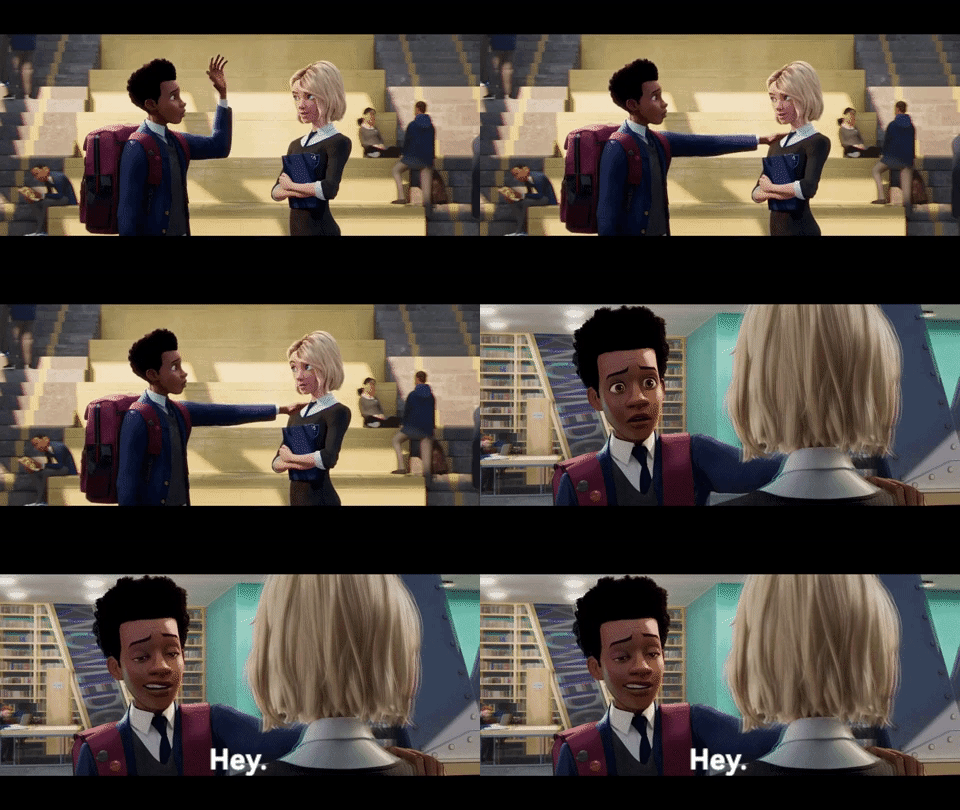
By adding a red circle and text telling you where to look, I have changed the salience of this gif, therefore reframing it in your mind.



 𝘾𝙪𝙧𝙡𝙚𝙮 🤘🏽